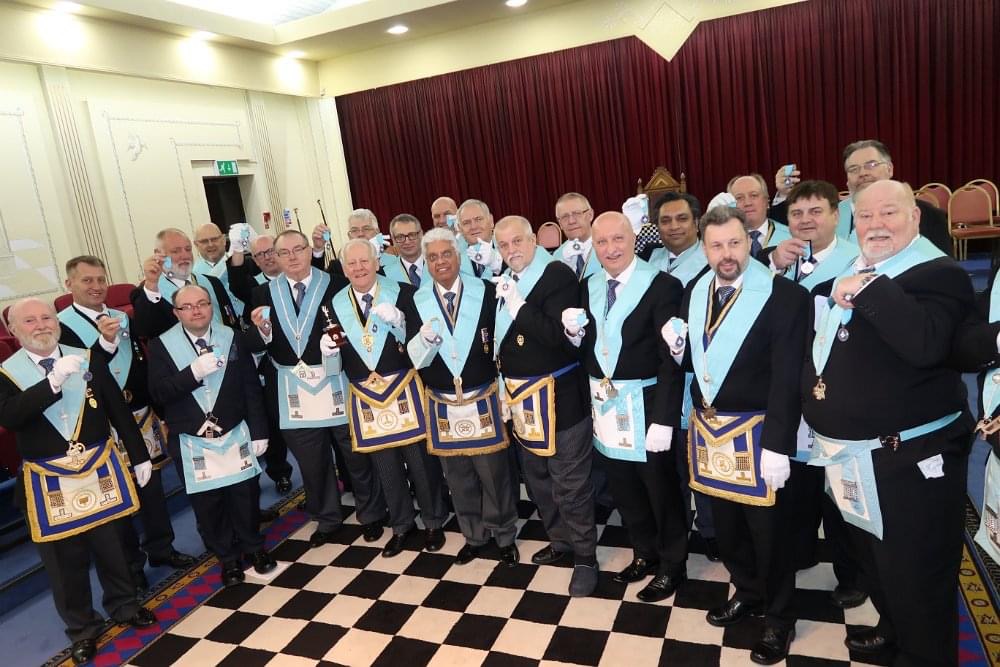
Founders and their Jewels
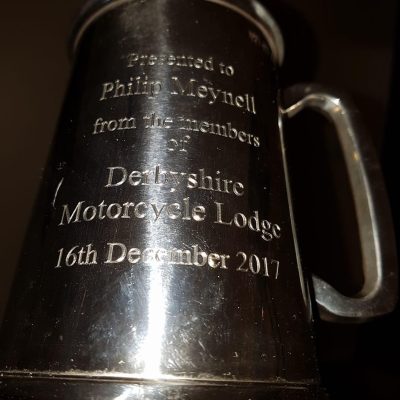
The concept of a Motorcycle Lodge in Derbyshire was the brainwave of W Bro Philip Meynell, following a talk given by the Provincial Grand Master, where special interest Lodges were mentioned. Casual discussions amongst motorcycling freemasons and a conversation at a Festive Board concerning the formation of a new Lodge for those who have an interest in motorcycles aroused several people’s interest. The Province gave its approval in principle and the idea soon became a concept. W Bro Philip Wright was recruited as the Primus Master and W Bro Stephen Gough took on the role of Founding Secretary. W Bro Philip Meynell and W Bro Ranjit Verma became the founding Senior and Junior wardens respectively. There were in total 24 Founders.
Another 6 Masons, who were unfortunately not qualified to be Founders, became Joining members at the first meeting. We also have had several initiates. The Consecration was on Saturday 16th December 2017 saw Derby Masonic Hall virtually full to the brim, with the Provincial Grand Master as Consecrating Officer and the Deputy Provincial Grand Master as Installing Officer, ably assisted by a full Provincial Team who all played their part. All 24 Founders, 29 members of the Provincial Team and 153 other visitors were present.
Amongst the visitors, several Motorcycle Lodges from all over the UK were represented including Mike Hailwood Lodge 9839, Isle of Man TT Lodge 9872, Sussex Motorcycle Lodge 9871, Buckinghamshire Motorcycle Lodge 9926 and Le Willows Lodge 3852. A good representation of Derbyshire Masters was also in attendance. The Derbyshire Motorcycle Lodge 9950 will meet five times a year at Long Eaton Masonic Hall, Long Eaton, to which we relocated in mid-2024 due to the increasing size of the lodge. Previously, we spent over six years meeting at Ilkeston’s Masonic Hall. We are very grateful for the donation of regalia and other lodge furniture from the now-closed Kinder Scout Lodge 4532 (Derbyshire) and Sure & Stedfast Lodge 9326 (W. Lancs.), as well as for the kind generosity of W Bro Malcolm Prentice.
We would like it to be known that our Founders are Freemasons first and foremost, with an interest in Motorcycles. Not the other way round. That will remain the ethos for the membership of the Lodge. Membership is not restricted to owning or riding a motorbike. A keen interest will suffice.
We welcome visitors to our meetings and anyone wishing to attend is assured of a fraternal, warm and sincere welcome.
What is Freemasonry?
When did Freemasonry begin?
The history of Freemasonry traces back to the early 17th century, with the formation of the Grand Lodge of England in 1717 being a significant turning point. However, the origins of Freemasonry ranging from ancient builders to medieval stonemasons.
Regardless of its exact beginnings, Freemasonry has played a prominent role in shaping social, political, and cultural landscapes throughout history. From its symbolic ceremonies and moral teachings to its influence on Enlightenment ideals, Freemasonry continues to intrigue and captivate individuals around the world.
Freemasonry is one of the world’s oldest social and charitable organisations, with its origins rooted in the traditions of the medieval stonemasons who built our cathedrals and castles.
It is here that a number of the famous elements of Freemasonry find their roots. In the medieval era, stonemasons often travelled around to find work in different locations. To demonstrate their level of qualification, they would use grips, words and signs in order to distinguish themselves from unqualified builders.
Freemasonry uses building analogies to teach members how to lead productive lives that benefit the communities that they live in. In the medieval era, stonemasons wore aprons and gloves to protect themselves while working on shaping rough pieces of stone, but in today’s society Freemasons meet to build friendships and communities rather than cathedrals and castles.
Freemasons use four key values to help define their path through life: Integrity, Friendship, Respect, and Service. Those values, upheld by its members, offer a framework for making better choices in life and living a more fulfilling and purposeful existence.
Guiding principles of Freemasonry
What do Freemasons believe? For Freemasons, there are four important values that help define their path through life: Integrity, Friendship, Respect and Service. In today’s world filled with uncertainty, these principles ring as true now as they have at any point in the organisation’s history.

INTEGRITY
Honesty, trustworthiness, honour, reliability, and conscientiousness form the foundation of a virtuous character. They foster trust, maintain integrity, and demonstrate commitment, ultimately leading to a life of strong principles and dependable actions.

FRIENDSHIP
Freemasonry gives members many opportunities to make a wide circle of friends for life who share common interests and values. It provides a bond of friendship and a sense of belonging. This promotes a feeling of enjoyment and fulfilment.

RESPECT
From its earliest days, Freemasonry has respected the beliefs of its members. It promotes an environment where diversity is valued. It is a space where different beliefs and backgrounds converge, fostering an atmosphere of inclusivity, tolerance and harmony.

SERVICE
Whether participating in events, fundraising for a charitable cause or volunteering for public or community organisations, service is at the very heart of Freemasonry. Our members make valuable contributions by donating time, resources and skills.
Our Mission
Mission Statement
What we are (purpose)
We are a unique members’ organisation that has thrived for over 300 years. Having no political or religious affiliations, we comprise members of all ages, races, religions, cultures and backgrounds. We meet in our individual Lodges throughout the country where we have ceremonial traditions which encourage us both to be more tolerant and respectful and actively to fulfil our civic and charitable responsibilities; we also make time to eat, drink and meet together, and form lifelong friendships.
What we aim for (vision)
To attract those from all backgrounds and walks of life, enabling them to develop into more thoughtful and confident people. To inspire and challenge them to practise the core values we celebrate – Integrity, Friendship, Respect, Service – in their private and public lives. To cement our reputation as a force for good in our communities and society at large and as a thriving organisation that people aspire to join.
How will we achieve this? (mission)
Over the next 7 years, we will enhance our reputation as a thriving organisation that people aspire to join and broaden our membership across all age groups.